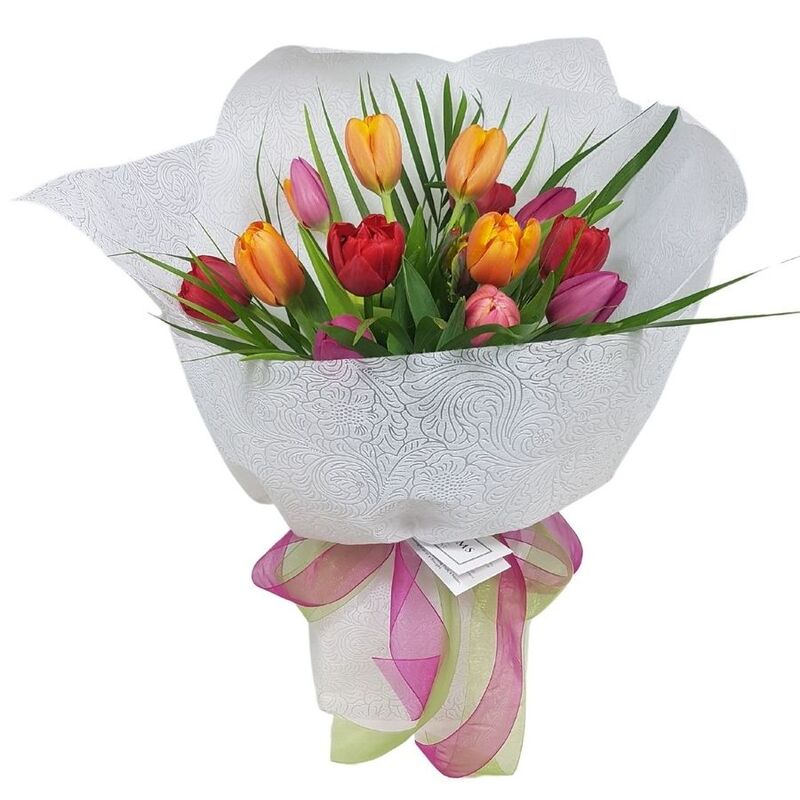
Tulips are one of the most recognisable and loved spring flowers, with their elegant stems, distinctive cup-shaped blooms and gorgeous range of colours. Although we think of tulips as a true sign that spring has arrived, here in Auckland we are lucky to start seeing fresh cut tulips during the winter months - always a welcome splash of colour on a grey winter's day.
As florists, one of the things we love most about tulips is that they don't stay still. Unlike many cut flowers, tulips continue to grow and move after they have been arranged. They stretch upwards, bend towards the light and gradually open their petals, so a vase of tulips can look quite different from one day to the next.
From their origins in Central Asia and their extraordinary role in Dutch history, to tulip meanings, colours, varieties and the best way to care for cut tulips, there is much more to this beautiful spring flower than meets the eye.
Tulips are traditionally a spring flower in New Zealand, flowering in gardens as the weather begins to warm. However, the season for fresh cut tulips is longer than many people expect.
At Best Blooms in Auckland, we usually start receiving fresh tulips from our growers in late April, early May, with supplies continuing through winter and spring until approximately September or October. Exact availability can vary from year to year, depending on the weather, growers and the varieties being produced.
This means that although tulips are famous as spring flowers, you can often buy fresh tulip bouquets in Auckland well before spring officially begins.
There is a clever bit of flower growing behind those early tulips.
Tulips naturally come from regions with very cold winters, and the bulbs need a period of cold temperatures for the flower bud inside the bulb to develop properly. Commercial growers can manage this cold period carefully, helping produce cut tulips earlier than they would naturally flower outside in the garden.
For home gardeners in warmer parts of New Zealand, including Auckland, tulip bulbs may also need to be chilled before planting. Importantly, tulip bulbs are chilled, not frozen. A refrigerator provides the cold conditions they need; freezing temperatures can damage or kill the bulbs.
This combination of clever growing techniques and carefully managed temperatures is one of the reasons we can enjoy fresh New Zealand tulips while it still feels very much like winter outside.
This is one of our favourite things about tulips - cut tulips continue to grow after they have been picked.
Put a fresh bunch into a vase and watch them over the next few days. The stems will continue to lengthen and the flowers will bend and turn towards the light. Research into cut tulips has found that stems can continue growing significantly after harvest - sometimes by several centimetres.
It means tulips have a wonderfully natural, almost unruly personality in a vase. A neat arrangement on Monday may have developed long, sweeping stems and flowers pointing in completely different directions by Wednesday.
As florists, we take this movement into account when arranging tulips. We may place them slightly lower amongst other flowers because we know they are going to keep stretching upwards after they leave our shop.
Tulips respond to light, so you will often notice the flowers leaning towards a sunny window. This is part of what makes a vase of tulips feel so alive - the arrangement genuinely changes as the flowers grow, open and follow the light.
If all your tulips start leaning enthusiastically in one direction, simply turn the vase around. Or leave them to it. We rather like the wild, graceful shapes tulips make when they're allowed to do their own thing.
Fresh tulips are surprisingly easy to care for, but because their stems continue growing and they are thirsty flowers, a little attention will help you enjoy them for longer.
As a general guide, fresh cut tulips can last around five to seven days in a vase, although good-quality flowers that are very fresh when purchased can often give you longer. Their vase life will depend on how fresh they were to begin with, the room temperature and how well they are cared for.
Don't be too quick to decide your tulips are past their best simply because they have started bending. Curving stems and wide-open flowers are a natural part of the tulip's vase life, and many people think this relaxed, dancing stage is when tulips are at their most beautiful.
One of the joys of tulips is watching them change - from tight, neat buds when they first arrive to open, expressive flowers several days later.
Tulips are most often associated with love, happiness and the arrival of spring. As one of the most eagerly awaited flowers of the new season, they are also associated with renewal, fresh beginnings and optimism.
Like many flowers, the meaning of a tulip can change depending on its colour. Flower symbolism has evolved over centuries and varies between cultures, so there are no hard-and-fast rules, but some meanings have become traditionally associated with particular tulip colours.
Mixed tulips have a charm all of their own. Rather than conveying one particular message, a colourful bunch feels joyful, fresh and full of spring. We love the way the different colours open and mingle together as the tulips grow and move in the vase.
Ask most people where tulips come from and the answer will probably be Holland. Surprisingly, tulips are not originally Dutch.
Wild tulips originated across a broad region of Central Asia, where they evolved in landscapes with cold winters and hot, dry summers. Over time, tulips were cultivated and treasured in Persia and later became particularly important in the Ottoman Empire, centuries before the flower became famous in the Netherlands.
By the 16th century, tulips were highly prized in the gardens of the Ottoman Empire. They appeared not only in gardens, but also in art, textiles and decorative designs.
From the Ottoman world, tulips travelled into Western Europe during the 1500s. Their striking shape, vivid colours and rarity fascinated botanists, collectors and wealthy garden owners - and eventually the Dutch became particularly captivated by them.
Even the name "tulip" has an intriguing history.
The word is generally traced through the Turkish word tülbend, derived from a Persian word associated with a turban. Early European accounts appear to have connected the flower with the shape or appearance of a turban, and versions of the word gradually evolved into the name we now know as tulip.
Whether you see a turban when you look at a tulip is another matter, but it certainly gives this elegant flower one of the more interesting name stories in the flower world.
Although the Dutch didn't discover tulips, they certainly fell in love with them.
Tulips reached Western Europe in the 16th century and became especially sought after in the Netherlands. The climate and growing conditions suited the bulbs, while collectors became fascinated by rare varieties, unusual colours and spectacular markings.
Some of the most desirable tulips had dramatic streaks or feathered flames of contrasting colour running through their petals. At the time, growers did not understand what caused these extraordinary patterns. We now know that many of the famous "broken" tulips were affected by a plant virus that altered the pigmentation of their petals.
The rarer and more spectacular the flower, the more desirable its bulb became. Eventually the fascination with unusual tulips contributed to one of the strangest and most famous chapters in flower history.
During the 1630s, enthusiasm for rare tulips in the Dutch Republic developed into the period now famously known as Tulip Mania.
Rare varieties had become fashionable status symbols, and some tulip bulbs began changing hands for extraordinary sums. Instead of buying a bulb simply to plant and enjoy its flower, traders began buying and selling contracts for particular bulbs in the hope that their value would continue to rise.
At the height of the excitement, some of the rarest varieties were associated with astonishing prices. Then, in 1637, confidence in the market suddenly faltered and prices collapsed.
Tulip Mania has since become one of history's most famous stories about speculation, fashion and the extraordinary value people can place on something simply because it is beautiful, fashionable and rare.
You will often hear the claim that during Tulip Mania a single tulip bulb could cost more than a house. There is some truth behind the stories of extraordinary prices, but the popular version of Tulip Mania has grown considerably in the telling.
Historical records do show remarkable prices being discussed or paid for a small number of exceptionally rare bulbs. However, modern historians generally consider the familiar story of ordinary Dutch people selling their homes and possessions to gamble everything on tulips to be exaggerated. The speculative market involved a much smaller part of society than the legend suggests.
Even allowing for a few centuries of embellishment, the value attached to the rarest tulips was extraordinary. Almost 400 years later, Tulip Mania remains part of our language whenever people talk about speculation, soaring prices and financial bubbles.
One of the most celebrated tulips of the period was the Semper Augustus. Its white petals were marked with dramatic, flame-like streaks of red, making it exceptionally rare and desirable.
Ironically, the spectacular colouring that made tulips like this so valuable wasn't the result of clever breeding. It was caused by what we now call the tulip breaking virus, which interfered with the flower's natural pigmentation and created those striking streaks and feathered patterns.
Modern striped and multi-coloured tulips are bred to produce beautiful markings without relying on the disease that created some of the most famous flowers of the 17th century.
Nearly four centuries after Tulip Mania, the relationship between the Netherlands and tulips is stronger than ever.
Generations of specialist growers, suitable growing conditions and an enormous international flower industry have helped make the Netherlands one of the world's great centres for flower bulbs and cut flowers. Today, vast fields of flowering bulbs are one of the most recognisable images of the Dutch countryside.
Every northern spring, flower lovers travel from around the world to see the Dutch bulb fields in bloom and visit spectacular flower displays such as the famous Keukenhof Gardens.
Orange has a special place in Dutch culture because of the Dutch royal family, the House of Orange-Nassau. Although orange doesn't appear on the Dutch flag, it has become the country's unofficial national colour and you'll see it everywhere during major Dutch celebrations, royal occasions and sporting events.
Naturally, orange tulips make a particularly appropriate Dutch-inspired gift, but tulips of any colour can have a lovely connection with the Netherlands.
Here at Best Blooms, we regularly have customers asking for tulips for Dutch family members living in Auckland. Mother's Day is one occasion when we receive special requests for tulips for Mum - perhaps a little reminder of Holland and spring, delivered here in New Zealand.
There are thousands of cultivated tulip varieties around the world, ranging from the simple classic shape we all recognise to extraordinary flowers that barely look like tulips at first glance.
Some of the different types of tulips you may come across include:
Not every tulip variety is grown commercially as a cut flower in New Zealand, and the varieties available to florists can change throughout the season. That's part of the pleasure of working with seasonal flowers - sometimes something particularly beautiful or unusual arrives from our growers and we simply have to make the most of it.
If tulips are your favourite flowers, their relatively short season makes them feel all the more special. At Best Blooms, our Auckland florists usually have fresh cut tulips available from around late May through winter and into spring, with varieties and colours changing as the season progresses.
We don't offer tulip bouquets in every individual colour. Instead, we love using the beautiful mixed tulips available from our growers, either gathered together in a colourful tulip bouquet or combined with other seasonal blooms.
During the season you may also find tulips mixed with favourites such as freesias, daffodils and other spring flowers. As with all seasonal flowers, availability depends on what is fresh and beautiful at the flower markets that week.
For more information about what's flowering throughout the year, read our guide to flowers in season in New Zealand.
If you've enjoyed learning all about tulips, discover more flower stories, meanings, varieties and florist tips in our Flowers in Focus series:
Or explore our Flower Library to discover more about popular flowers, their meanings, fascinating histories, seasonal availability and how to care for your favourite blooms.

Jo-Ann Moss is the Creative Director at Best Blooms, an Auckland florist providing fresh flower delivery across the city. Jo-Ann writes about flower gifting, floral care tips, and how to choose the right bouquet for every occasion.
07 July 2021, 10:47 PM
Like this article 837 others enjoyed this article
Seasonal Flowers in New Zealand
Traditional Wedding Anniversary Gifts by Year NZ (1849 likes)
🌸 Birth Flowers NZ, Birthstones & Star Signs – A Fun NZ Guide (1753 likes)
10 Tips How to make your Flowers live Longer - Flower Care Tips NZ (1646 likes)
Christmas Celebrations - Guide to New Zealand's most popular Flowers at Christmas (1545 likes)
Why Best Blooms Loves New Zealand Grown Flowers (1501 likes)